Keep the cap and call the surgeon who placed the implant the same day. Do not screw it back in yourself. Each implant system has its own driver and tightening procedure, and a cap that is not seated correctly can fit poorly and let fluid leak into the implant connection.1
Losing the cap breaks the soft-tissue barrier around the implant. In a pilot study of 12 patients, the 3 whose healing abutment had dislodged showed a disrupted epithelial barrier and pronounced infiltration of immune cells in the surrounding gum.2 No published timeline says how fast the gum covers the opening.
What to do in the first few hours
A healing cap is a healing abutment, the part that sits on the implant and helps the gum heal around it.3
- Find the cap and keep it. Bring it to the visit. The clinic decides whether it can go back on. The instructions for one common line, Dentsply Sirona HealDesign EV and Healing Abutment EV, say the parts are delivered sterile for single use only, and that reuse may lead to infection or fracture of components.1 They do not say a cap that just fell out cannot go back on the same day. That call belongs to the clinician.
- Call the surgeon the same day. A Methodist Health System patient page lists an abutment that feels loose among the reasons to call the surgeon, next to bleeding that will not stop, jaw, mouth or sinus pain that prescribed medicine does not relieve, and a fever over 100.4 °F (38 °C).3 In a 2026 study, surgeons faced with a dislodged abutment at 3 to 4 weeks held off on immediate re-intervention to protect the bone around the implant and chose watchful waiting instead.2 What is right depends on timing and healing, which is why the call comes first.
- Do not screw it back in. Each system uses its own driver and tightening procedure.
- Watch for signs of a problem beyond the cap. The University of Nevada, Las Vegas dental school notified 184 patients treated from 2014 to 2017 after healing abutments were reused. Its release lists swelling, severe pain, discomfort, gum inflammation, and loosening or movement of the implant as symptoms of implant failure.4 The 184 is a count of patients notified, not of failures. Only an exam can tell a loose cap from a moving implant.
Why healing caps come loose
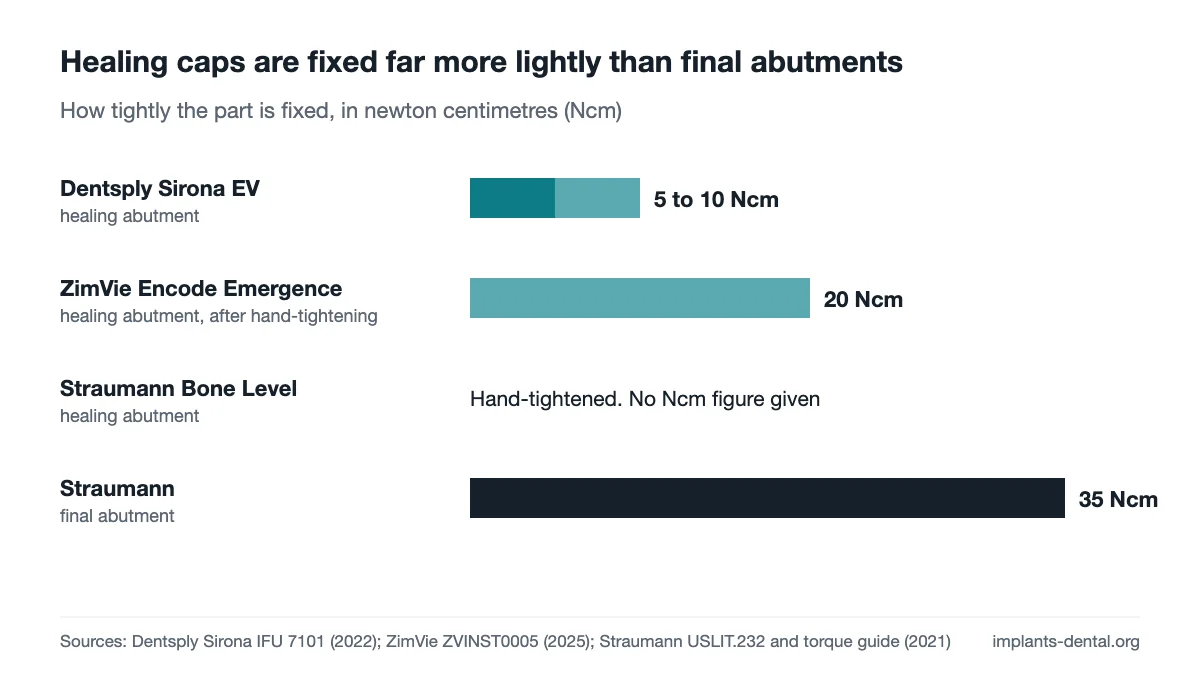
Manufacturers set healing caps lightly. Dentsply Sirona tells clinicians to tighten its EV healing abutments by hand with light finger force (5 to 10 Ncm, a unit of tightening torque).1 That figure covers DS Implants EV and Astra Tech EV connections and no other product. Other makers use other steps.
| System | How the cap is tightened | Source |
|---|---|---|
| Dentsply Sirona, DS Implants EV and Astra Tech EV | Manually, with light finger force (5 to 10 Ncm)1 | Instructions for Use 7101, 2022 |
| Straumann Bone Level | Hand-tightened with the SCS screwdriver5 | Technical Information USLIT.232, 2019 |
| ZimVie Encode Emergence | Hand-tightened, then 20 Ncm with a restorative torque wrench for this coded healing abutment6 | Surgical manual ZVINST0005, 2025 |
| Straumann final abutments | 35 Ncm with a torque control device, for implant-level abutments7 | Torque Control and Screwdrivers, 2021 |
Healing caps are held far more loosely than final abutments. A final abutment is tightened by hand first and then torqued to 35 Ncm in one uninterrupted movement; the healing abutment on the same system is hand-tightened only.75
Authors who study dislodgement name two causes: bone left from surgery kept the abutment from seating fully, or a counterclockwise force was applied to it during cleaning or eating.2 They call dislodgement “not uncommon” but give no incidence.2
The connection design also matters. A lab study of 88 implants (44 internal hex, 44 conical) held for 2 weeks in four media, including saliva, blood and chlorhexidine, tightened every abutment to 25 Ncm first. For the MIS Seven implants, reverse torque values stayed below 25 Ncm in every contamination group. For the MIS C1 implants, they exceeded 25 Ncm in the saliva and blood groups, and chlorhexidine reduced them.8 These are lab values, not a clinical loosening rate.
Over-tightening has its own cost. One technique report, a single case, describes an over-torqued healing abutment that a conventional prosthetic driver could not remove because of damage within the abutment's prosthetic channel.9
What happens to the gum while the cap is out
Most of what is published describes tissue around a cap that stays in place. In 21 patients with biopsies at 2, 4, 8 or 12 weeks, the soft tissue at 8 weeks was about 3.6 mm tall (1.9 mm of barrier epithelium over 1.7 mm of connective tissue) and changed little by 12 weeks.10 A dog study with 20 animals found the first epithelial proliferation at 1 to 2 weeks, organised collagen fibres at 4 to 6 weeks and a mature barrier epithelium at 6 to 8 weeks.11 In 76 patients with 102 implants, tissue height around the healing abutment tended to stabilise about 6 weeks after second-stage surgery.12 These figures describe maturation with the cap in place. No published study measures how fast the gum closes over the opening after a cap is lost.
What a lost cap does is better documented than how quickly the gum closes. The 12-patient study compared 4 groups of 3: dislodgement, a pre-implant site, a fully closed site and a partially closed site. The dislodged abutments in the 3 patients came off at 21, 22 and 28 days, and biopsies were taken at about 4 months. Neutrophils, macrophages, T cells, B cells and plasma cells were present at significantly higher densities in the dislodgement group.2 The authors call it an exploratory pilot study, and it was not randomized. It shows immune cells moving in. It does not measure infection or implant failure.2
There is also a practical cost. In a randomized trial of 66 implants in 45 patients (34 healing abutment, 32 cover screw), the healing abutment technique avoided flap re-entry. At 6 months implant survival was 100%, with one mucositis case in the healing abutment group.13 The trial did not report cap loss.
Can you put it back yourself?
No. The Dentsply instructions say the component has to be correctly seated to prevent misfit and possible leakage into the implant connection, and that it must be unloaded during healing.1 Straumann lists its SCS screwdriver as the instrument for healing caps, abutments and impression posts.7 ZimVie calls for a restorative torque wrench and a torque wrench hex driver at 20 Ncm for its coded healing abutment.6
Three makers give three procedures: light finger force at 5 to 10 Ncm, hand-tightening with a system screwdriver, and hand-tightening followed by 20 Ncm with a torque wrench.156 Doing it correctly at home would mean knowing which system you have, owning its matching driver and knowing its tightening procedure.
If you swallowed it or cannot find it
The Dentsply instructions warn that components dropped in the patient's mouth may be swallowed or aspirated, which can result in suffocation or physical injury, and the adverse reactions they list include aspirated or swallowed components.1
A literature review pooled 57 published cases from 1984 to 2021 of aspirated dental items. Dental crowns and prostheses made up 43.85%, implant material 19.29% and teeth 15.78%. Most of these events happened in the dental chair, and the pool is a set of case reports, not an incidence. The authors name bronchoscopy as the treatment of choice for removing an aspirated foreign body.14 If the cap came off during a meal, you cannot find it and you coughed or choked, get medical care.
University of Washington authors write that the ingestion or aspiration of dental instruments, particularly implant-related components, poses serious medical risks, and that standardized protocols or professional guidelines for these events are lacking.15
What the dentist will do, and what happens to the crown
The 2026 dislodgement study gives one picture of the reasoning. Dental implants go through a “stability dip” around 3 to 4 weeks after placement, when osteoclastic remodelling is relatively active and new bone formation and mineralisation are not yet fully established. The abutments in the 3 patients dislodged at that point, so the team avoided immediate re-intervention and biopsy to protect the bone-implant interface, and used watchful waiting. The authors still advise prompt restoration of the barrier with anti-inflammatory and antimicrobial measures where it is compromised, and proper seating and tightening torque at surgery to lower the risk of dislodgement.2 This is one centre's report, not a guideline.
No source reviewed here reports how often a lost cap ends in another procedure. The trial above shows only that a cap left in place spares the patient a flap re-entry.13
If a cap keeps coming off, the abutment gets removed and reconnected each time. A meta-analysis of 10 randomized trials (753 implants, 573 patients, single-tooth implants, follow-up of 12 months or more) compared one abutment placed once with repeated abutment changes. Survival was 99.43% against 99.25%, and bone resorption was slightly lower with one abutment (P = 0.0518), a difference the authors call marginally statistically significant.16 Those were planned changes, not accidental cap loss.
The Methodist page says it usually takes 4 to 6 weeks for gums to heal around abutments.3 None of the sources reviewed here reports whether losing a cap delays the crown.
Questions patients ask
Is a loose healing cap an emergency?
The sources treat it as a same-day call to the surgeon. A loose abutment sits on the Methodist list of reasons to call, alongside bleeding that will not stop and a fever over 100.4 °F (38 °C).3 A swallowed or inhaled cap is different: if you coughed or choked, get medical care.14
Will I need another surgery?
No source reviewed here says. In the one study that followed three dislodgements at 3 to 4 weeks, the team chose watchful waiting over immediate re-intervention.2 A healing abutment left in place avoids flap re-entry.13
Does it mean the implant failed?
Only an exam can tell. The UNLV release lists swelling, severe pain, discomfort, gum inflammation, and loosening or movement of the implant as symptoms of implant failure.4
References
- Dentsply Sirona. Instructions for Use: DS Implants HealDesign EV / Healing Abutment EV. IFU 7101-en_US Rev. 002 B, 2022-11. Dentsply Implants Manufacturing GmbH. https://www.dentsplysirona.com/content/dam/master/product-procedure-brand-categories/implant-dentistry/product-categories/cover-screws---healing-abutments/healing-abutments/ifu/7101/IMP-US-IFU-HealDesign-EV-Healing-Abutment-EV-EN-US-7101-2022-11.pdf (accessed October 2026)
- Liu G, Liu Y, Hou Y, Lin J, Chen X, Liu R. Immunological Features of Peri-Implant Soft Tissue After Healing Abutment Dislodgement: A Comparative Human Study. International Dental Journal. 2026;76(3):109521. doi:10.1016/j.identj.2026.109521. PMID 41875836
- Methodist Health System. Dental Implants: Placing Abutments and Making Your Prosthesis. HealthHub health library, last reviewed June 2025. https://healthlibrary.methodisthealthsystem.org/dental-care/treatment/dental-implants-placing-abutments-and-making-your-prosthesis (accessed October 2026)
- University of Nevada, Las Vegas. UNLV School of Dental Medicine Notifying Patients About Potential Device Failure. News release, 2018. https://www.unlv.edu/news/release/unlv-school-dental-medicine-notifying-patients-about-potential-device-failure (accessed October 2026)
- Straumann USA. Technical Information: Straumann Bone Level Prosthetic Procedures. USLIT.232 12/17 V1, 2019. https://www.straumann.com/content/dam/media-center/straumann/en-us/documents/brochure/product-information/USLIT232-Technical-Info-on-Bone-Level-Prosthetic-Procedures.pdf (accessed October 2026)
- ZimVie. The Encode Emergence Impression System: surgical manual. ZVINST0005-GLBL REV D 11/25, 2025. https://www.zimvie.com/content/dam/zimvie-corporate/en/dental/literature/zvinst0005/zvinst0005_encode_emergence_surgical_manual_final.pdf (accessed October 2026)
- Straumann. Straumann Torque Control and Screwdrivers (Torque Control Device). 2021, English. https://media.skill.straumann.com/straumann/TrainingTemplates/15815/AssociatedFiles/Torque%20Control%20Device_2021_english%20(1).pdf (accessed October 2026)
- Levartovsky S, Ronen G, Raz P, Beitlitum I. Effect of Fluid Contamination on Reverse Torque of Healing Abutments in Two Implant Connection Systems: In Vitro Study. Clinical Implant Dentistry and Related Research. 2025;27(3):e70056. doi:10.1111/cid.70056. PMID 40420559
- Nasehi A, Kurtz KS, Delgado-Ruiz R, Swanson PH. Retrieving a “frozen” over-torqued altered dental implant healing abutment: A dental technique. Journal of Prosthodontics. 2026;35(5):776–779. doi:10.1111/jopr.14045. PMID 40108999
- Tomasi C, Tessarolo F, Caola I, Wennström J, Nollo G, Berglundh T. Morphogenesis of peri-implant mucosa revisited: an experimental study in humans. Clinical Oral Implants Research. 2014;25(9):997–1003. doi:10.1111/clr.12223. PMID 23799997
- Berglundh T, Abrahamsson I, Welander M, Lang NP, Lindhe J. Morphogenesis of the peri-implant mucosa: an experimental study in dogs. Clinical Oral Implants Research. 2007;18(1):1–8. doi:10.1111/j.1600-0501.2006.01380.x. PMID 17224016
- Chen Y, Ding J, Xu Z, et al. Supracrestal Tissue Height Changes Around the Healing Abutment in the Posterior Region After Second-Stage Implant Surgery Measured by Intraoral Scanning: A Retrospective Study. Clinical Oral Implants Research. 2026;37(8):1008–1019. doi:10.1111/clr.70145. PMID 42226387
- Prati C, Spinelli A, Lenzi J, Carboni D, Chersoni S, Gandolfi MG, Zamparini F. Clinical parameters of implants placed bone level with cover screw or healing abutment techniques. 6 months post-surgery report from a randomized controlled clinical trial. Oral and Maxillofacial Surgery. 2026;30(1):18. doi:10.1007/s10006-025-01499-0. PMID 41559425
- Araujo SCS, Bustamante JED, de Souza AAB, Peixoto LC, Amaral MBF. Aspiration of dental items: Case report with literature review and proposed management algorithm. Journal of Stomatology, Oral and Maxillofacial Surgery. 2022;123(4):452–458. doi:10.1016/j.jormas.2021.10.009. PMID 34687948
- Hess TA, Wadhwani CPK, Dodson TB, Truelove EL. Foreign Body Ingestion or Inhalation Management for Dental Offices. Compendium of Continuing Education in Dentistry. 2025;46(9):418–422. PMID 41628001
- Lorenz J, Peham F, Urich J, Weigl P, Fritsch M, Sader R. Effects of repeated abutment changes on implant success and bone resorption: Systematic review and meta-analysis. International Journal of Oral Implantology. 2025;18(4):309–318. PMID 41342573
This page describes published clinical practice. It is not a treatment plan, and it does not replace an examination.