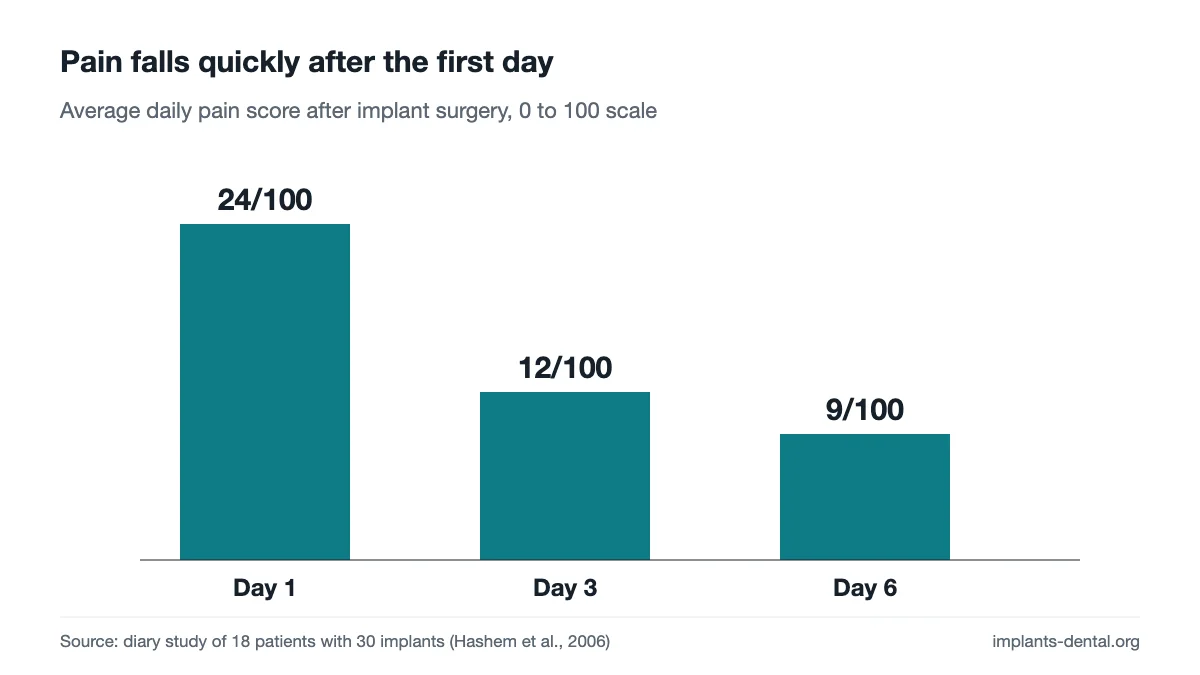
Pain after implant surgery is usually worst in the first hours and on day 1, then falls quickly. In a diary study of 18 patients, average pain scores were 24 out of 100 on day 1, 12 on day 3 and 9 on day 6.1
Swelling follows a different schedule. In a study of 41 patients, pain peaked 6 hours after surgery in 41.5% of cases, and swelling peaked at 48 hours in 48.8%.2 Guy's and St Thomas' NHS Foundation Trust tells implant patients that discomfort should only last up to a week.3
The pain clock: first hours, day 1, day 3
The clearest day-by-day record comes from a small diary study at Trinity College Dublin dental school. Eighteen patients with 30 implants scored their average pain each day on a 100-point scale. The mean was 24 on day 1, 12 on day 3 and 9 on day 6.1 Worst pain and limits on daily activities were also highest on day 1, and both fell to about half their maximum by the second or third day. No patient reported high levels of any symptom.1
A larger study followed 234 patients and 510 implants at two centres in Kuwait. Mean pain on a 0 to 10 scale was highest at 24 hours, at 2.01 ± 0.11, and decreased gradually after that. Pain was mild for most patients at every time point, and only a few had moderate or severe pain.4
Studies that measured pain earlier found the peak in the first hours. In Valencia, 41 patients with 131 implants had surgery under local anaesthesia. Pain peaked 6 hours after the operation in 41.5% of cases, and most patients who had pain called it slight.2 In Aarhus, 92 patients who had immediate single implants in molar sites with grafting had their highest pain at 5 to 6 hours, a mean of 25 out of 100.5 One study recorded peak pain on day 2, but its first questionnaire after surgery was on day 2, so it could not catch an earlier peak.6 The peak therefore falls somewhere between the first few hours and the first day or two.
| Study | Population | Peak | Later values |
|---|---|---|---|
| Dublin1 | 18 patients, 30 implants | Day 1: average pain 24/100 | Day 3: 12. Day 6: 9 |
| Valencia2 | 41 patients, 131 implants, local anaesthesia | Pain peaked at 6 hours in 41.5% of cases | Swelling peaked at 48 hours in 48.8%. Followed for the first week |
| Kuwait4 | 234 patients, 510 implants | 24 hours: mean 2.01 ± 0.11 on a 0 to 10 scale | Decreased gradually. Followed for 12 weeks |
| Aarhus5 | 92 patients, immediate single molar implants with grafting | 5 to 6 hours: mean VAS 25/100 | Swelling peaked on day 1 (mean VAS 62/100). Followed to day 3 |
| Qingdao7 | Single implant with simultaneous bone regeneration, 30 patients analysed | 4 hours | Followed for 72 hours |
| Marquette6 | 26 patients, single implant, two-stage protocol | Day 2 (first questionnaire was on day 2) | Followed for 2 months |
The swelling and bruising clock
At Marquette University, researchers scanned the soft tissue of 26 patients after placement of a single implant and compared each scan with one taken right after surgery. Ridge width grew by 1.9 mm, ridge height by 1.4 mm and volume by 37.8%, all at their highest on day 2. Width was back to its immediate post-surgery level by day 7. Patients reported their worst pain, swelling and difficulty opening the mouth at that same point.6
The Valencia study agrees: swelling peaked at 48 hours in 48.8% of cases and was moderate in most patients who reported pain.2 The Aarhus group, with grafted immediate molar implants, saw it peak on day 1, at a mean of 62 out of 100.5
Swelling is also more common than pain. Among 506 patients at Peking University School and Hospital of Stomatology, swelling occurred in 65.6% (47.0% mild, 18.6% moderate to severe) and pain in 55.6% (51.4% mild, 4.2% moderate to severe). The abstract does not state when the symptoms were scored.8
Bruising lasts a different length of time. In a study of patient records from one private office in Italy, lateral sinus lift patients reported swelling in 97.36% of cases, lasting a mean of 4.09 ± 1.43 days. Bruising occurred in 51.32%, lasting a mean of 2.21 ± 2.31 days.9
Why some surgeries hurt more
Bone grafting is the clearest example. In Qingdao, 30 patients who had a single implant with simultaneous guided bone regeneration averaged 4.77 on a 0 to 10 pain scale, against 2.93 for 30 patients with an implant alone. Their pain peaked at 4 hours and was moderate. The difference between groups was statistically significant at 4 hours (p = 0.002; 95% CI −2.98 to −0.69), at 6 hours (p = 0.001; 95% CI −2.40 to −0.67) and at 24 hours (p = 0.003; 95% CI −1.05 to −0.22).7
The number of implants matters too. In the Valencia study, swelling was linked to older age, to placing more than four implants, and to sinus lift or bone regeneration. Pain was linked to the number of implants placed.2 In the 506-patient Beijing group, pain was associated with multiple sites and with bone substitute use.8 Smoking adds to it: in the Aarhus group of 92 patients, 35 of them smokers, pain scores were higher for smokers at every time point, with a significant difference from day 1 until day 3 (0.011 < P < 0.048).5
In a randomised trial in Lyon, 30 patients had flapless placement of 80 implants and 30 had open-flap surgery for 72 implants. Pain scores were higher with open-flap surgery (P < .01), and 43% of flapless patients felt no pain on the day of surgery against 20% of open-flap patients. Pain decreased faster after flapless surgery (P = .05), and those patients took fewer pain tablets (P = .03).10 A 2012 Cochrane review found significantly less postoperative pain with flapless placement in 2 trials with 56 patients, and called the evidence limited and weak, with 1 of 6 included trials at low risk of bias.11
For sinus lifts, a 2026 meta-analysis of 12 studies (11 randomised trials and 1 non-randomised) found less pain at 3 and 7 days with the graftless approach than with grafting, and less discomfort with the transcrestal route than the lateral one. Ten studies were at moderate risk of bias and 1 at high risk, and the authors describe a paucity of evidence.12 After lateral sinus augmentation in a trial of 60 patients at Griffith University, mild to moderate pain and interference with daily activities lasted 48 to 72 hours, and NSAIDs alone were enough.13
Pain relief
Guy's and St Thomas' advises regular painkillers such as paracetamol or ibuprofen, which most people need. It says to take them before the local anaesthetic wears off and for the first 48 hours (2 days) after treatment. To limit swelling, it says to hold ice packs on the area for 10 minutes each hour during the first 6 hours.3
The American Dental Association (ADA) issued a 2024 guideline on acute dental pain. For surgical tooth extraction it suggests starting with an NSAID alone (for example 400 mg of ibuprofen or 440 mg of naproxen sodium) or with acetaminophen (for example 500 mg), a conditional recommendation of low certainty. It advises avoiding routine just-in-case prescribing of opioids.14 The guideline was written for extractions and toothache, and its evidence base is 82 randomised trials in people having surgical tooth extraction. It does not cover implant surgery.14
The one implant-specific review gives a mixed picture. It covered 7 randomised trials with 589 patients who took anti-inflammatory drugs before implant surgery. Favourable results were reported for etoricoxib, ibuprofen and nimesulide in single-implant procedures. The trials differed too much in protocols, drug regimens and outcome measures for the authors to say which drug works best or is safest.15
Pain that is not normal
Cleveland Clinic calls slight discomfort and swelling normal after surgery and says you should feel like yourself within a week or so.17 Its list of reasons to call your dentist at any time includes fever, pus or bleeding around the implant, swollen gums, an implant that feels loose, and swollen neck lymph nodes when they come with another of these signs.17 Guy's and St Thomas' adds one more: if bleeding does not stop, go to the nearest emergency department.3
One US military chart review shows how often these problems occur, with a limit on what it can tell you. It covered 1,135 periodontal and implant-related surgeries by periodontics residents at the Army Postgraduate Dental School from 2018 to 2022. Postoperative complications occurred in 15.2% of procedures, including excessive pain in 2.5% and infection in 2.2%. The surgeries were a mix of gum and implant procedures, so these are not implant-only rates. Guided bone regeneration (OR 3.0, 95% CI 1.4 to 6.5) and guided bone regeneration with implant placement (OR 3.1, 95% CI 1.3 to 7.6) were associated with higher odds of a postoperative complication.16
Numbness is a different problem
Nerve injury looks different from surgical pain. A literature review of PubMed papers from 2000 to 2010 describes damage to the third branch of the trigeminal nerve as a sensory deficit that is not usually associated with pain and is generally transient. Postoperative pain, in the same review, comes from inflammation after tissue damage.18
For lower-jaw implants, a meta-analysis of 9 studies estimated the risk of neurosensory disturbance at 13.50 per 100 person-years (95% CI 10.98 to 16.03) and the recovery rate at 51.30 per 100 person-years (95% CI 31.2 to 71.4). The authors note that many recover spontaneously.19 Person-years count time at risk, so 13.50 per 100 person-years is not 13.5% of patients. It is an estimate from one meta-analysis.
A systematic review of 6 articles on inferior alveolar nerve injury after implant placement, published between 2004 and 2014, concluded that early diagnosis and treatment matter.20
Questions patients ask
Is it normal to still have pain after a week?
Guy's and St Thomas' says discomfort should only last up to a week, and Cleveland Clinic says you should feel like yourself within a week or so.317 Neither source gives a figure for pain that continues past that point. Cleveland Clinic lists signs to call about at any time, including a loose implant, fever and pus.17
Does a bone graft make recovery more painful?
In a Qingdao cohort of 60 analysed patients, a single implant with simultaneous guided bone regeneration averaged 4.77 on a 0 to 10 pain scale, against 2.93 for an implant alone. The difference was statistically significant at 4, 6 and 24 hours after surgery.7
Can I go back to work the next day?
Guy's and St Thomas' says: "You can return to work on the day after your treatment."3
References
- Hashem AA, Claffey NM, O'Connell B. Pain and anxiety following the placement of dental implants. Int J Oral Maxillofac Implants. 2006;21(6):943–950. PMID 17190305
- González-Santana H, Peñarrocha-Diago M, Guarinos-Carbó J, Balaguer-Martínez J. Pain and inflammation in 41 patients following the placement of 131 dental implants. Med Oral Patol Oral Cir Bucal. 2005;10(3):258–263. PMID 15876971
- Guy's and St Thomas' NHS Foundation Trust. After having a dental implant. 2024 (reviewed December 2024). guysandstthomas.nhs.uk/health-information/dental-implants/after-having-dental-implant. Accessed October 2026.
- Al-Khabbaz AK, Griffin TJ, Al-Shammari KF. Assessment of pain associated with the surgical placement of dental implants. J Periodontol. 2007;78(2):239–246. doi:10.1902/jop.2007.060032
- Urban T, Wenzel A. Discomfort experienced after immediate implant placement associated with three different regenerative techniques. Clin Oral Implants Res. 2010;21(11):1271–1277. doi:10.1111/j.1600-0501.2010.01943.x
- Kofina V, Valencia Rincon J, Rawal SY, Dentino AR, Han S, Tatakis DN. Implant placement-associated tissue swelling: a digital three-dimensional and patient-based assessment. Clin Oral Investig. 2025;29(4):212. doi:10.1007/s00784-025-06284-7
- Gao X, Zhang X, Wang Y, Deng Y, Wang M. Effect of Simultaneous Guided Bone Regeneration on Postoperative Pain Three Days After Dental Implant Surgery: A Prospective Cohort Study. J Oral Rehabil. 2026;53(8):1466–1473. doi:10.1111/joor.70199
- Ma X, Zeng H, Li Y, Yang Y. Development of Multiple Risk Prediction Models for Postoperative Symptoms Following Dental Implant Surgery. J Oral Rehabil. 2026;53(4):916–923. doi:10.1111/joor.70146
- Rengo C, Fiorino A, Cucchi A, Nappo A, Randellini E, Calamai P, Ferrari M. Patient-reported outcomes and complication rates after lateral maxillary sinus floor elevation: a prospective study. Clin Oral Investig. 2021;25(7):4431–4444. doi:10.1007/s00784-020-03755-x
- Fortin T, Bosson JL, Isidori M, Blanchet E. Effect of flapless surgery on pain experienced in implant placement using an image-guided system. Int J Oral Maxillofac Implants. 2006;21(2):298–304. PMID 16634502
- Esposito M, Maghaireh H, Grusovin MG, Ziounas I, Worthington HV. Interventions for replacing missing teeth: management of soft tissues for dental implants. Cochrane Database Syst Rev. 2012;(2):CD006697. doi:10.1002/14651858.CD006697.pub2
- Menini M, Canullo L, Pesce P, Bixio F, Bagnasco F, Del Fabbro M. Patient-Reported Outcome Measures (PROMs) in Sinus Elevation Procedures: A Systematic Review and Meta-analysis. Int J Oral Maxillofac Implants. 2026;41(5):557–566. doi:10.11607/jomi.11434
- Alayan J, Ivanovski S. A prospective controlled trial comparing xenograft/autogenous bone and collagen-stabilized xenograft for maxillary sinus augmentation: complications, patient-reported outcomes and volumetric analysis. Clin Oral Implants Res. 2018;29(2):248–262. doi:10.1111/clr.13107
- Carrasco-Labra A, Polk DE, Urquhart O, et al. Evidence-based clinical practice guideline for the pharmacologic management of acute dental pain in adolescents, adults, and older adults. J Am Dent Assoc. 2024;155(2):102–117.e9. doi:10.1016/j.adaj.2023.10.009
- Gomes da Frota E, Bergamaschi CC, Lopes LC, de Deus Lages LP, Motta RHL. Preemptive Analgesia With Steroidal and Nonsteroidal Anti-Inflammatory Drugs in Dental Implant Surgeries: A Systematic Review. J Oral Implantol. 2026;52(3):225–234. doi:10.1563/aaid-joi-D-24-00009
- Blyleven GM, Johnson TM, Inouye KA, Stancoven BW, Lincicum AR. Factors influencing intraoperative and postoperative complication occurrence: A series of 1135 periodontal and implant-related surgeries. Clin Exp Dent Res. 2024;10(1):e849. doi:10.1002/cre2.849
- Cleveland Clinic. Dental Implants. 2026. my.clevelandclinic.org/health/treatments/10903-dental-implants. Accessed October 2026.
- Palma-Carrió C, Balaguer-Martínez J, Peñarrocha-Oltra D, Peñarrocha-Diago M. Irritative and sensory disturbances in oral implantology. Literature review. Med Oral Patol Oral Cir Bucal. 2011;16(7):e1043–e1046. doi:10.4317/medoral.17125
- Padmanabhan H, Kumar AV, Shivashankar K. Incidence of neurosensory disturbance in mandibular implant surgery: a meta-analysis. J Indian Prosthodont Soc. 2020;20(1):17–26. doi:10.4103/jips.jips_373_19
- Shavit I, Juodzbalys G. Inferior alveolar nerve injuries following implant placement: importance of early diagnosis and treatment: a systematic review. J Oral Maxillofac Res. 2014;5(4):e2. doi:10.5037/jomr.2014.5402
This page describes published clinical practice. It is not a treatment plan, and it does not replace an examination.