The difference is whether the gum is closed over the implant while it heals. In two-stage surgery the fixture is buried under the gum, and a second minor procedure uncovers it months later. In one-stage surgery a healing abutment is attached straight away, so the implant stays visible above the gum and no second procedure is needed.1
Surgeons choose two-stage when the implant needs protection while it heals, either after bone grafting or when the fixture is not firmly held at placement. One-stage is used when the implant is stable from the start and the surrounding gum is healthy.4
What happens in each approach
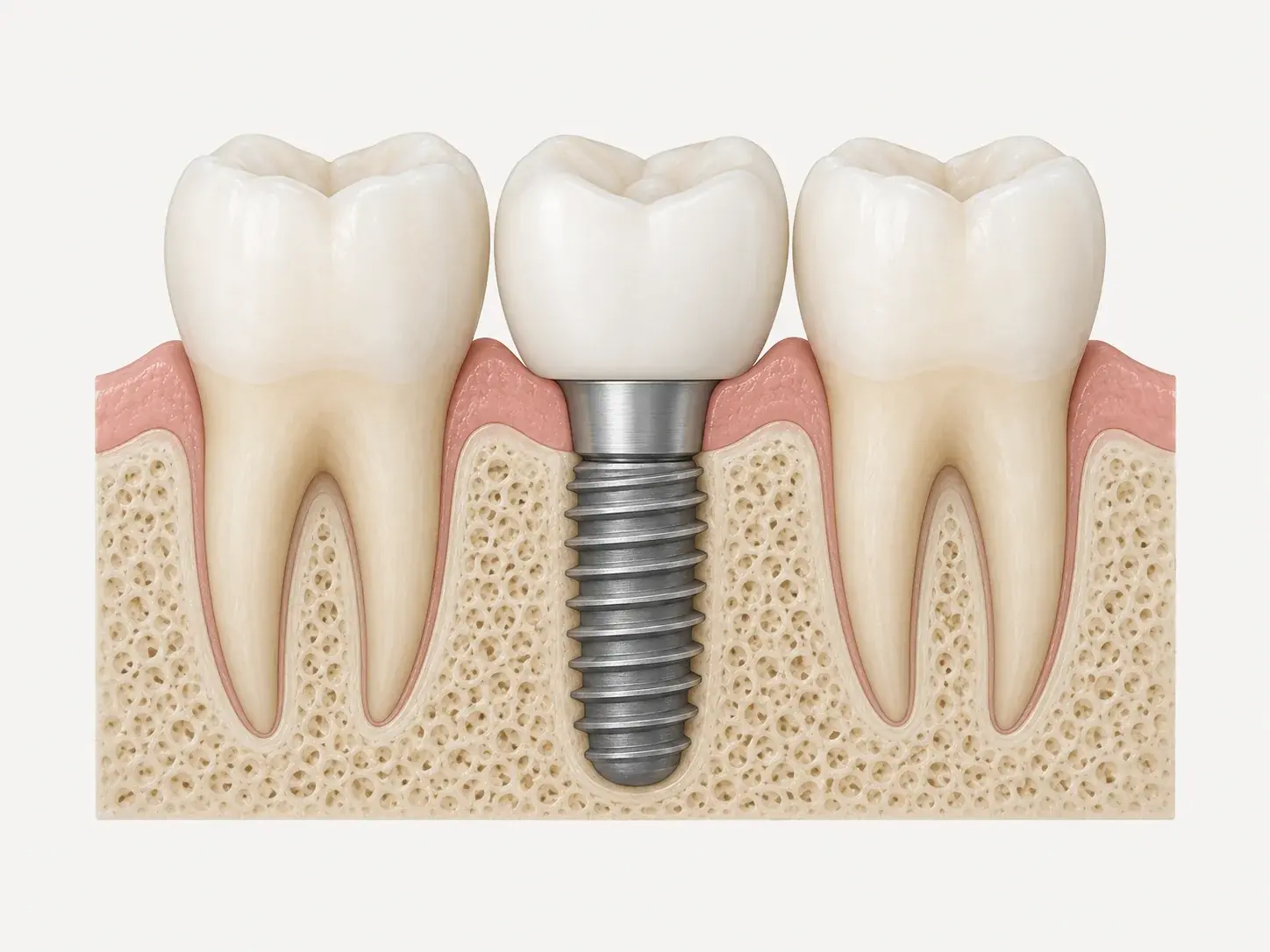
Both approaches place the same titanium fixture in the same position. What differs is what covers it during the months when bone grows onto its surface, a process called osseointegration.
Two-stage
A cover screw is fitted to the top of the fixture and the gum is stitched closed over it. Nothing is visible in the mouth while the bone heals. At the second stage the surgeon reopens a small area of gum, removes the cover screw and fits a healing abutment, which shapes the gum before the crown is made.1
One-stage
A healing abutment is attached at the time of placement, and the gum is stitched around it rather than over it. The abutment stays visible in the mouth for the whole healing period. When healing is complete the abutment is unscrewed and the crown goes on, with no further surgery.
What decides the choice
The decision is often made in the operating chair rather than beforehand, because it depends on how firmly the fixture sits once it is in the bone.4
- Primary stability. If the fixture is tight in the bone at placement it can usually be left exposed. If it is not, burying it protects it from being loaded too early.
- Bone grafting at the same time. Grafted bone and membranes generally heal better under closed gum, which points to two stages.4
- Thickness and health of the gum. Thin or inflamed tissue around an exposed abutment is harder to keep clean.
- Position in the mouth. Front teeth, where appearance governs the result, are handled differently from back teeth.
In short
- Two-stage needs a second small procedure. One-stage does not.
- Two-stage is the safer choice when bone was grafted, or when the fixture is not firmly held.
- Pooled trials find no significant difference in overall implant failure. The differences that do show up are in early failure and marginal bone, and they are small.23
Side by side
| Two-stage | One-stage | |
|---|---|---|
| During healing | Buried under closed gum | Healing abutment visible in the mouth |
| Second procedure | Required, to uncover the implant | Not required |
| Used when | Bone was grafted, or the fixture is not firmly held | The fixture is stable and the gum is healthy |
| Gum shaping | Begins after the second procedure | Begins immediately |
| Implant failure | No significant difference in overall failure2 | No significant difference in overall failure; early failure about 2 percentage points higher in one analysis3 |
| Marginal bone | 0.12 mm more loss, judged not clinically relevant2 | 0.13 mm better preserved at one year3 |
Where the implant sits either way
Questions patients ask
Is the second procedure painful?
It is much smaller than the first. The surgeon opens a small area of gum over the implant under local anesthetic and fits the healing abutment. No bone work is involved.
Will there be a gap in my mouth while it heals?
Not necessarily. A temporary tooth can usually be worn during healing under either approach, though what is possible depends on the site and on how the implant is being protected.
Does one approach last longer than the other?
Pooled analyses of randomized trials found no significant difference in overall implant failure between the two. One review reported early failure about 2 percentage points higher when the implant was left exposed. The two reviews put the bone-level difference at 0.12 mm and 0.13 mm, in opposite directions, and the authors of the first did not consider it clinically relevant.23
Can the plan change during surgery?
Yes, and that is normal. A surgeon who intended one stage may bury the implant after finding the bone softer than expected.
References
- Implants. MouthHealthy, American Dental Association. Accessed 16 September 2026.
- Moustafa Ali RM, Alqutaibi AY, El-Din Gomaa AS, Abdallah MF. Effect of submerged vs nonsubmerged implant placement protocols on implant failure and marginal bone loss: a systematic review and meta-analysis. International Journal of Prosthodontics, 2018;31(1):15–22. doi:10.11607/ijp.5315
- Troiano G, Lo Russo L, Canullo L, Ciavarella D, Lo Muzio L, Laino L. Early and late implant failure of submerged versus non-submerged implant healing: a systematic review, meta-analysis and trial sequential analysis. Journal of Clinical Periodontology, 2018;45(5):613–623. doi:10.1111/jcpe.12890
- Esposito M, Grusovin MG, Chew YS, Coulthard P, Worthington HV. One-stage versus two-stage implant placement: a Cochrane systematic review of randomised controlled clinical trials. European Journal of Oral Implantology, 2009;2(2):91–99. The Cochrane version of this review was withdrawn in 2018 as out of date; the findings are cited here as published in 2009.
This page describes published clinical practice. It is not a treatment plan, and it does not replace an examination.