For a standard implant, the University of Rochester sheet allows nothing by mouth for the first hour, then liquids and soft, cool foods. It says to avoid very hot food and drink for 24 hours, and hard, crispy foods such as chips, hard pretzels and popcorn for two weeks.1 The Guy's and St Thomas' NHS leaflet is looser: you should be able to eat normally, and your dentist might recommend soft foods.2
Same-day teeth are a different case. Published immediate-load protocols used soft diets for 6 weeks after single-tooth provisional crowns, 3 months in grafted full-arch maxillae and 4 months with zygomatic implants.345
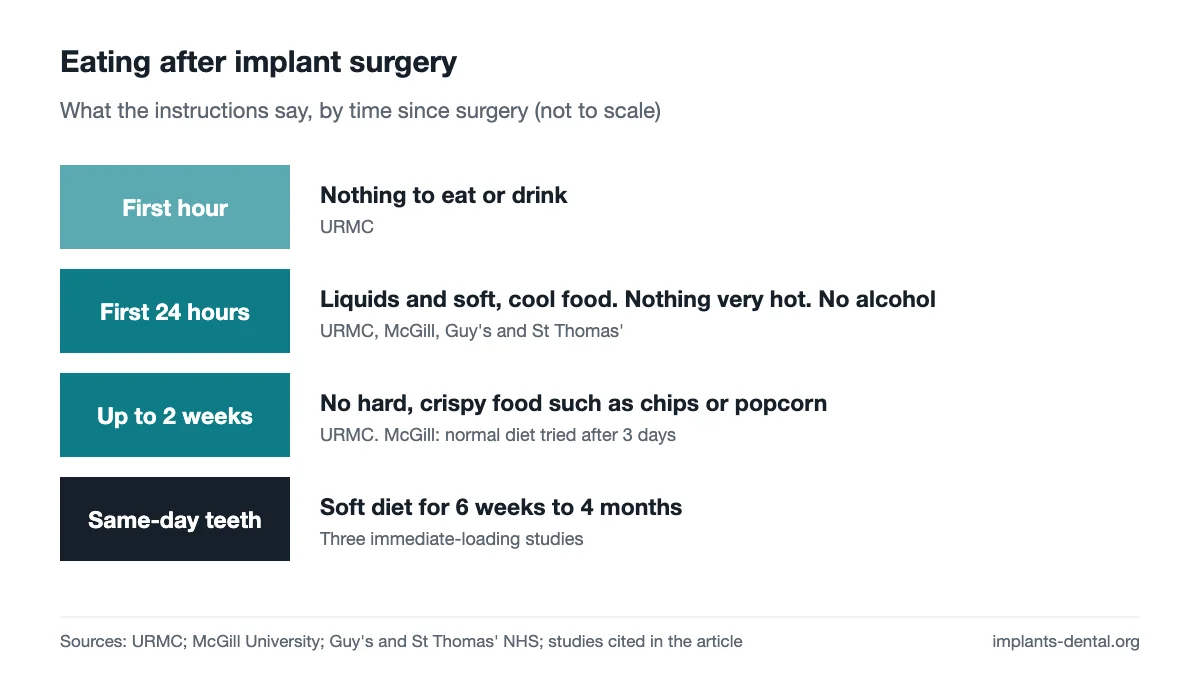
The first 24 hours
The University of Rochester Medical Center (URMC) sheet starts with a wait: no eating or drinking in the first hour after surgery. After that, drink plenty of liquids and eat soft, cool foods. Excessively hot liquids and foods are out for the first 24 hours.1
McGill University's list of suggested foods runs to soups, noodles, scrambled eggs, pasta, pudding, yogurt, ice cream, juices, milkshakes and pancakes, plus anything soft you can tolerate, with lots of fluids to stay hydrated.6 Both McGill and Guy's and St Thomas' rule out alcohol for the first 24 hours. McGill adds that alcohol should stay off the list for as long as you take narcotic pain medication and antibiotics.62
One more leaflet is worth knowing, with a caveat. East Kent Hospitals covers surgery in the mouth in general, not implants alone. It says to eat only a soft diet, such as mashed potato, scrambled eggs or yoghurt, for the first 48 hours, and to take no hot or fridge-cold food or drink for the rest of the day, because it encourages the wound to bleed.7 On cold food that is stricter than URMC, which recommends cool foods.
The first one to two weeks
Sources differ widely on how long to stay on a soft diet. McGill says to try to resume a normal diet after the first 3 days, with a softer diet if that feels more comfortable at first.6 URMC plans for liquids on the day of surgery, soft "mushy" foods during the first week, advancing to regular food as tolerated. After the first two weeks it adds fish, chicken, meatloaf, mashed potatoes, cooked vegetables, soups and cereals, then regular food.1 So the range for a standard case runs from about 3 days to 2 weeks.
Two other sources decline to give a number. The American Association of Oral and Maxillofacial Surgeons (AAOMS) says a soft diet is usually recommended during the early stages of healing, and that your surgeon will give guidelines tailored to your situation.8 Mayo Clinic says you may need soft foods after each stage of surgery while the site heals, and that after the abutment is placed the gums must heal for at least two weeks before the artificial tooth is attached.9
Cleveland Clinic gives no diet instructions, but it puts the first round of healing at about one week, against three to nine months for the bone to fuse with the implant. It also says you should feel like yourself within a week or so.10
| Window | What the instructions say | Source |
|---|---|---|
| First hour | Nothing to eat or drink | URMC1 |
| First 24 hours | Liquids and soft, cool foods; nothing excessively hot; no alcohol | URMC, McGill, Guy's and St Thomas'162 |
| Week 1 | Soft "mushy" foods advancing to regular food as tolerated (URMC); normal diet after the first 3 days (McGill) | URMC, McGill16 |
| Weeks 1 to 2 | No hard, crispy foods for two weeks (URMC); no hard, crunchy foods for at least 5 days (McGill); dentures may stay out for up to 2 weeks; stitches out at 7 to 14 days | URMC, McGill, Guy's and St Thomas'162 |
| After 2 weeks | Gradually add fish, chicken, meatloaf, mashed potatoes, cooked vegetables, soups and cereals, then regular food | URMC1 |
| Immediate-load cases | Soft diet for 6 weeks to 4 months in published protocols | Three clinical studies345 |
Foods to avoid and why
Hard and crunchy foods lead every list. URMC names chips, hard pretzels and popcorn for the first two weeks.1 McGill names chips too, for at least 5 days, because they may disturb the surgery site.6 If you had a graft at the same visit, McGill adds a separate line: avoid chewing or creating pressure on the graft site.6
The East Kent leaflet, written for surgery in the mouth in general, gives two more. Avoid small foods such as peas and rice until the wound has healed, and avoid sharp foods such as crisps, which can hurt the wound and cause unnecessary pain.7
One rule outlasts healing. Once the crown is on, Mayo Clinic says not to chew hard items such as ice and hard candy, which can break your crowns or your natural teeth.9
Straws and hot drinks
The two universities that mention straws disagree on how long to avoid them. McGill says not to rinse your mouth or use a straw for the next 24 hours.6 URMC says no straws for the first week, because suction could dislodge the blood clots that normally form, and its sheet words this as "extraction sites" even though it is written for implants.1
Patients who had a sinus procedure get stricter instructions. The URMC sheet tells them to do nothing that needs a sucking-in or blowing-out motion, such as smoking, straws or blowing up balloons. That section gives no duration.1 If your surgeon lifted the sinus, the suction rule has its own reason. See sinus lift.
The only trial found on straws was done after wisdom-tooth extraction, not implant placement. It followed 60 patients who had all four third molars removed (220 teeth). Thirty used straws with all meals for 2 days and 30 did not. Dry socket occurred in 8 patients (15%) who used a straw and 9 (15%) who did not, and the author reported no evidence of a higher rate with straws in the first 2 days.11 The no-straw rule comes from instruction sheets, and the one trial comes from extractions.
For hot drinks, URMC says to avoid excessively hot liquids and foods for 24 hours.1 East Kent says no hot or fridge-cold food or drink for the rest of the day.7
Same-day teeth and full arches: why the soft diet lasts longer
When teeth go on the implants the same day, the soft diet protects the whole restoration, and the published periods are much longer. In a randomized trial of single-tooth immediate provisional crowns in the upper front and premolar area (50 implants in 48 patients, 12 months of follow-up), patients were told to eat a soft diet and keep food away from the provisional crown for the first 6 weeks. That instruction applied to both groups and was not what the trial tested.3
A case series of 15 patients with 90 implants (6 per maxillary arch) used immediate loading with a splinted acrylic provisional for 6 to 8 weeks. In grafted sites the provisional stayed for 3 months, and a soft or liquid diet was recommended for that period. Survival was 96.66% (3 failures) after a mean loading time of 42.4 ± 19.15 months, with no comparison group. The authors say immediate loading in the maxilla works when primary stability, cross-arch stabilization and a soft diet for the initial stages of healing are all in place.4
In 25 consecutive patients with severely resorbed upper jaws, 47 zygomatic and 129 regular implants carried a bridge within 24 hours in 19 patients and after 5 days in 6. Patients were told to follow a soft diet for 4 months. Cumulative survival was 100% for zygomatic implants and 99.2% for regular implants over 2 to 5 years, again with no comparison group.5
A measurement study shows the mechanism. Ten healthy subjects each wore a fixed partial denture on two implants in the premolar or molar area, with sensors recording the forces. Chewing gummy bears gave mean vertical forces between 264 and 284 N across the three fixed partial dentures tested, and these were not significantly different from each other. Bread gave lower mean vertical forces and bending moments. The authors suggest soft food during healing in cases of immediate loading.12
None of these studies used the All-on-4 design, so their diet periods are not an All-on-4 rule. For the surgery itself, see same-day implants and All-on-4.
Protein and supplements
AAOMS says surgery in the mouth, including placement of dental implants, does not require a significant increase in nutrients. Your surgeon will suggest a liquid or soft diet for a short time, which the page does not define. It also advises avoiding carbonated beverages, drinking through a straw, vigorous tooth brushing and mouth rinsing, since these can disrupt clotting and healing. The same page says the average adult should drink six to eight glasses of fluids per day.13
A scoping review of 19 studies covered vitamin D, magnesium, resveratrol, vitamin C, a calcium, magnesium, zinc and vitamin D mix, and a synthetic bone mineral, with an expert panel of 11 specialists. It found a limited role for dietary supplements in helping implants bond to bone. The exception is vitamin D deficiency, where it found a clear link between the deficit, reduced bonding and early implant failure. The evidence mixes human and animal work, with no pooled effect sizes.14
A 2025 systematic review found adequate vitamin D levels consistently associated with better implant outcomes, with higher bone density and stability. Vitamin C helped soft tissue healing but did not directly affect bone integration. These are associations, not trials of giving supplements to implant patients, and the authors say further research is needed before there are clinical guidelines.15
Questions patients ask
Can I drink coffee after implant surgery?
Not hot, for the first 24 hours. URMC tells patients to avoid excessively hot liquids and foods for 24 hours.1 A general oral surgery leaflet from East Kent Hospitals says no hot or fridge-cold food or drink for the rest of the day, because it encourages the wound to bleed.7
When can I eat normally?
Guy's and St Thomas' says you should be able to eat normally, and your dentist might recommend soft foods.2 McGill says to try to resume a normal diet after the first 3 days.6 URMC moves to regular food after the first two weeks, as tolerated.1 Long term, Mayo Clinic says not to chew ice or hard candy.9
Can I wear my denture?
Guy's and St Thomas' says that if you have dentures, you might not be able to wear them for up to 2 weeks after treatment.2
References
- University of Rochester Medical Center, Eastman Institute for Oral Health, Oral & Maxillofacial Surgery. Postoperative Instructions Following Dental Implants or Related Surgery. Undated patient instruction sheet. https://www.urmc.rochester.edu/urmcmedia/dentistry/patient/services/documents/postoperativeinstructionsfollowingdentalimplantsurgery.pdf (accessed October 2026)
- Guy's and St Thomas' NHS Foundation Trust. After having a dental implant. 2024. https://www.guysandstthomas.nhs.uk/health-information/dental-implants/after-having-dental-implant (accessed October 2026)
- Lindeboom JA, Frenken JW, Dubois L, Frank M, Abbink I, Kroon FH. Immediate loading versus immediate provisionalization of maxillary single-tooth replacements: a prospective randomized study with BioComp implants. J Oral Maxillofac Surg. 2006;64(6):936-42. doi:10.1016/j.joms.2006.02.015. PMID 16713809
- Romanos GE, Nentwig GH. Immediate functional loading in the maxilla using implants with platform switching: five-year results. Int J Oral Maxillofac Implants. 2009;24(6):1106-12. PMID 20162116
- Aparicio C, Ouazzani W, Aparicio A, et al. Immediate/Early loading of zygomatic implants: clinical experiences after 2 to 5 years of follow-up. Clin Implant Dent Relat Res. 2010;12 Suppl 1:e77-82. doi:10.1111/j.1708-8208.2008.00134.x. PMID 19076177
- McGill University, Department of Oral and Maxillofacial Surgery. Dental implants post-operative instructions. https://www.mcgill.ca/omfs/patient-info/dental-implants (accessed October 2026)
- East Kent Hospitals University NHS Foundation Trust, Day Surgery. Surgery in the mouth: aftercare advice. https://leaflets.ekhuft.nhs.uk/surgery-in-the-mouth-aftercare-advice/html (accessed October 2026)
- American Association of Oral and Maxillofacial Surgeons (AAOMS). Healing Process for Dental Implants. MyOMS.org. https://myoms.org/what-we-do/dental-implant-surgery/healing-process-for-dental-implants/ (accessed October 2026)
- Mayo Clinic Staff. Dental implant surgery. Mayo Clinic, 2024. https://www.mayoclinic.org/tests-procedures/dental-implant-surgery/about/pac-20384622 (accessed October 2026)
- Cleveland Clinic. Dental Implants. 2026. https://my.clevelandclinic.org/health/treatments/10903-dental-implants (accessed October 2026)
- Bloomer CR. Straws do not cause dry sockets when third molars are extracted. Tex Dent J. 2012;129(1):25-32. PMID 22432232
- Morneburg TR, Pröschel PA. In vivo forces on implants influenced by occlusal scheme and food consistency. Int J Prosthodont. 2003;16(5):481-6. PMID 14651231
- American Association of Oral and Maxillofacial Surgeons (AAOMS). Nutrition After Oral and Maxillofacial Surgery. MyOMS.org. https://myoms.org/nutrition-after-surgery/ (accessed October 2026)
- Nastri L, Moretti A, Migliaccio S, et al. Do Dietary Supplements and Nutraceuticals Have Effects on Dental Implant Osseointegration? A Scoping Review. Nutrients. 2020;12(1):268. doi:10.3390/nu12010268. PMID 31968626
- Ahmed MM, Bizzoca ME, Azad AK, et al. Assessing the influence of nutritional supplements on osseointegration outcomes in dental implantology: a systematic review. Minerva Dent Oral Sci. 2025;74(6):413-424. doi:10.23736/S2724-6329.25.05262-3. PMID 41258642
This page describes published clinical practice. It is not a treatment plan, and it does not replace an examination.