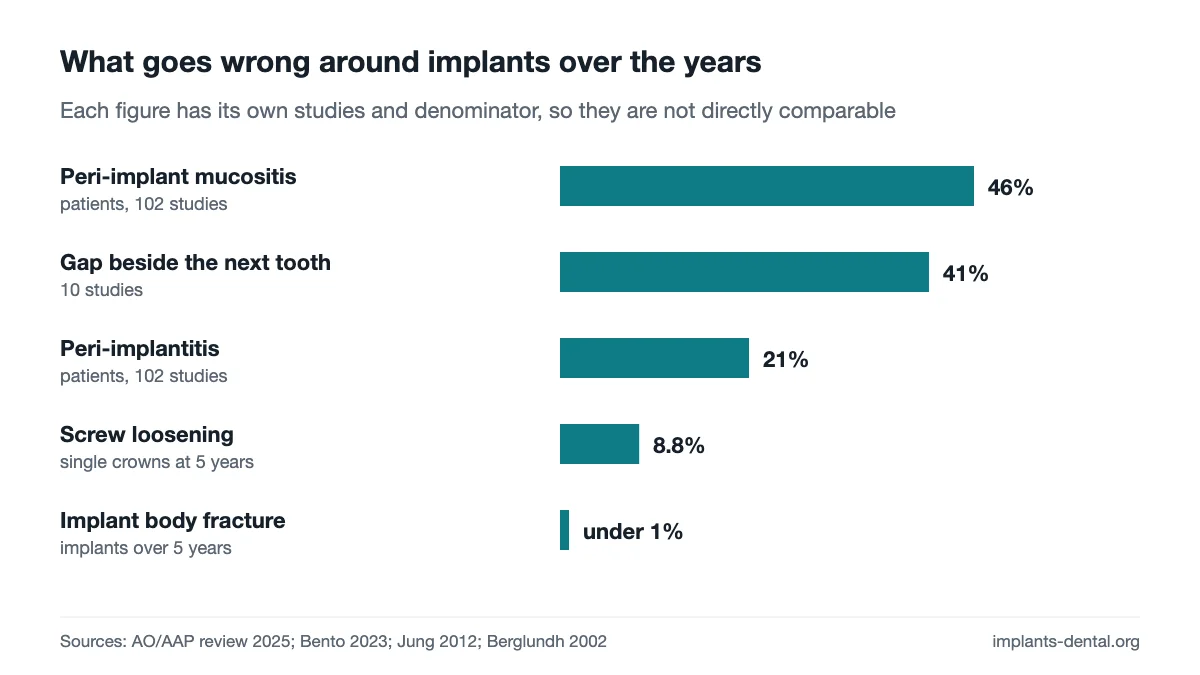
Pain from an implant that was fine for years has several possible sources. The most common long-term problem is inflammation around the implant: in an AO/AAP review, 46% of patients (95% CI 41 to 51) had peri-implant mucositis and 21% (95% CI 17 to 24) had peri-implantitis.1 Peri-implantitis often progresses with minimal or no symptoms, so pain is a late signal.8
There are mechanical causes too. Screw loosening occurred in 8.8% of single crowns at 5 years (95% CI 5.1 to 15.0).10 Across 10 studies, a gap between the crown and the neighbouring tooth had a pooled rate of 41% (CI 30% to 53%).14
Gum inflammation around the implant
Two conditions sit under this heading. Peri-implant mucositis is inflammation of the soft tissue around the implant. Its main sign is bleeding on gentle probing, and redness, swelling or pus may also be present.5 Peri-implantitis is a plaque-associated condition with inflammation in the tissue around the implant and progressive loss of the supporting bone.5 Mucositis is reversible at the host biomarker level, and it is considered the precursor of peri-implantitis.7
The AO/AAP systematic review pooled 102 studies and 13,030 patients. Prevalence at the patient level was 46% (95% CI 41 to 51) for mucositis and 21% (95% CI 17 to 24) for peri-implantitis. Within 20 years of function, the weighted mean incidence was 53% for mucositis and 22% for peri-implantitis.1 The same review reports that more than half of patients were affected over a 10-year follow-up period, with mucositis the most common condition.1
Other pooled estimates sit close to those. Twenty cross-sectional studies that used the 2017 World Workshop definitions found mucositis in 63.0% of patients (CI 57.6 to 68.2) and 59.2% of implants (CI 55.8 to 62.4). Peri-implantitis was found in 25.0% of patients (CI 21.1 to 29.3) and 18.0% of implants (CI 15.8 to 20.5). Risk of bias in those studies was high in 50%, moderate in 45% and low in 5%.2 An older review of 57 studies published from 2005 to 2021 gave 19.53% of patients (95% CI 12.87 to 26.19) and 12.53% of implants (95% CI 11.67 to 13.39), and it states that the figure remains highly variable even when only the clinical case definition is used.3 Estimates vary with the definition used, and the sources support a range of roughly one in five to one in four patients.123
For peri-implantitis, the AO/AAP review lists periodontitis, diabetes mellitus, smoking and alcohol consumption as significant risk indicators. It says only risk indicators could be identified, so none of these is a proven cause.1 Maintenance shows up in the data too. In a review of 57 studies from 1980 to March 2016, the median implant-level prevalence of peri-implantitis was 9.0% for regular participants of a prophylaxis program and 18.8% for patients without regular preventive maintenance.4
Why “it doesn’t hurt” does not mean healthy
Pain is not part of the consensus case definition for either condition.5 A 2026 review states that peri-implantitis often progresses with minimal or no subjective symptoms, which leaves a gap between the clinical findings and what the patient is aware of at diagnosis. It adds that many patients are diagnosed without prior awareness of the disease.8
What a dentist looks for is listed in the consensus report. Peri-implantitis sites show signs of inflammation, bleeding on probing and/or suppuration, increased probing depths and/or recession of the mucosal margin, together with bone loss on the x-ray.5 The American Academy of Periodontology describes the signs the patient can see as similar to gum disease: red or tender gums around the implants, or bleeding when brushing.9 The consensus report also recommends that the clinician take baseline x-ray and probing measurements once the implant crown is finished.5
The workshop review found that onset may occur early during follow-up and that the disease progresses in a non-linear and accelerating pattern. It reports strong evidence of higher risk in patients with a history of chronic periodontitis, poor plaque control skills and no regular maintenance care after implant therapy. It reports limited evidence for submucosal cement, lack of keratinized mucosa, and implant positions that make cleaning difficult.6 The AAP states that peri-implantitis usually requires surgical treatment.9
The crown or screw, not the implant
In a review of 46 studies with a mean follow-up of at least 5 years, survival of implants supporting single crowns was 97.2% at 5 years (95% CI 96.3 to 97.9) and 95.2% at 10 years (95% CI 91.8 to 97.2).10 The crown, screw and veneer have their own complication rates, listed in Table 1.
| Problem | How often | Population and follow-up | Source |
|---|---|---|---|
| Screw loosening | 8.8% (95% CI 5.1 to 15.0) | Single crowns, 46 studies, 5 years | Jung 201210 |
| Loss of retention | 4.1% (95% CI 2.2 to 7.5) | Single crowns, 46 studies, 5 years | Jung 201210 |
| Veneer fracture | 3.5% (95% CI 2.4 to 5.2) | Single crowns, 46 studies, 5 years | Jung 201210 |
| Soft tissue complications | 7.1% (95% CI 4.4 to 11.3) | Single crowns, 46 studies, 5 years | Jung 201210 |
| Bone loss over 2 mm | 5.2% (95% CI 3.1 to 8.6) | Single crowns, 46 studies, 5 years | Jung 201210 |
| Free of any complication | 66.4% of patients | Implant bridges, 32 studies, mean follow-up of at least 5 years | Pjetursson 201211 |
| Bridge veneer fracture | 13.5% | Implant bridges, 32 studies, mean follow-up of at least 5 years | Pjetursson 201211 |
| Bridge abutment or screw loosening | 5.3% | Implant bridges, 32 studies, mean follow-up of at least 5 years | Pjetursson 201211 |
| Implant body fracture | Under 1% of implants | 51 prospective studies, 5 years | Berglundh 200213 |
Screw loosening is the most frequent technical complication on a single crown.10 The bridge rows come from a separate review of implant-supported bridges, and they are not single-crown figures.11 The implant fracture figure dates from 2002, and the same abstract says complication data may be underestimated.13
Cement is a separate issue for cemented crowns. A review of 26 publications covering 945 subjects and 1010 cemented restorations found peri-implant disease on 1.9% to 75% of implants with cemented restorations, and 33% to 100% of those cases were associated with excess cement. The authors name excess cement as a possible risk indicator, seen more often when soft tissue healing periods were shorter than 4 weeks. The studies varied widely.12 The EFP says the dentist should check for cement deposits beneath the gums and around the implant.19
Food packing next to the implant
A gap can open over the years between the implant crown and the natural tooth beside it. A meta-analysis of 10 studies pooled the rate of open proximal contact at 41% (CI 30% to 53%), with wide variation between studies (I² = 98%).14 Another meta-analysis of 9 studies put contact loss at 46.3% (95% CI 32.3 to 60.6). It rose with observation time (OR 1.09; 95% CI 1.03 to 1.16) in two studies and was more frequent on the mesial side (the side facing the front of the mouth) in five studies (OR 2.25; 95% CI 1.06 to 4.77). That review covered 27 nonrandomized studies and 1,572 patients followed up to 18.5 years, and it rates the quality of evidence as very low because of bias.15
A qualitative review of 19 studies found contact loss in 11% to 30% of cases under 2 years, 13% to 65% at 2 to 5 years and 29% to 83.3% beyond 5 years.16 The reported consequences were food impaction and patient dissatisfaction. Bone loss, peri-implant inflammation, bleeding on probing and pocket depth had a less clear association with contact loss.16 The link to bone loss is therefore unsettled.
None of these reviews measured pain.
Bite and sinus
The evidence linking bite overload to bone loss is weak. A systematic review of studies that measured the bite quantitatively found a positive correlation between overload and crestal bone loss in 4 of 7 studies, and all 7 had moderate to serious overall risk of bias. The authors write that the data seem to reveal an association which must be further investigated.17 A possible link is as far as it goes.
For the sinus, a meta-analysis of 29 publications found that implants that perforated the sinus floor had a generally low failure rate, with only one case of transient sinusitis across 11 studies and an estimated failure of 2.1% (SE 1.0%). The authors say the risk of postoperative infection or sinusitis is low and may depend on the size of the perforation or the person’s anatomy.20 Sinus augmentation is covered on the sinus lift page.
When to book a visit, and what keeps problems away
Cleveland Clinic advises calling the dentist any time a patient with an implant notices a loose or wobbly implant, bleeding gums, fever, pus around the implant, swollen gums, or swollen lymph nodes in the neck along with one or more of the others.21
Timing matters because mucositis can be reversed.7 The European Federation of Periodontology says the earlier mucositis and peri-implantitis are detected, the better the chances of successful treatment.19 Its guideline calls for a structured supportive care programme once implants are in function, with periodical assessment of peri-implant tissue health, and describes peri-implantitis as particularly challenging to manage and accompanied by significant morbidity.18
The EFP patient page gives three practical points. Professional cleaning should be done at least twice a year. The dentist should check for deposits of cement beneath the gums and around the implant, a factor often associated with peri-implantitis. Patients who lost teeth because of periodontitis should keep in mind that implants are less resistant than teeth to the development and progression of disease.19
Cleveland Clinic also states that the restoration may need replacing at some point, with most crowns and bridges lasting around 15 years and most dentures at least seven years, and that the timeline varies. The page cites no study for those figures.21
Questions patients ask
Can an implant get infected years later?
Inflammation around an implant can develop long after placement. The AO/AAP review gives a weighted mean incidence of 53% for mucositis and 22% for peri-implantitis within 20 years of function.1 The workshop review says onset of peri-implantitis may occur early during follow-up and then progress in a non-linear and accelerating pattern.6
Is a loose implant crown an emergency?
Cleveland Clinic advises contacting the dentist any time you notice a loose or wobbly implant.21 Screw loosening is the most frequent technical complication on single crowns, at 8.8% at 5 years (95% CI 5.1 to 15.0).10
Does peri-implantitis always hurt?
No. A 2026 review states that it often progresses with minimal or no subjective symptoms, and that many patients are diagnosed without prior awareness of the disease.8 The consensus definition rests on bleeding on probing, suppuration, probing depth or recession, and bone loss on the x-ray.5
References
- Galarraga-Vinueza ME, Pagni S, Finkelman M, Schoenbaum T, Chambrone L. Prevalence, incidence, systemic, behavioral, and patient-related risk factors and indicators for peri-implant diseases: An AO/AAP systematic review and meta-analysis. Journal of Periodontology. 2025;96(6):587–633. doi:10.1002/JPER.24-0154. PMID 40489307
- Reis INRD, Huamán-Mendoza AA, Ramadan D, Honório HM, Naenni N, Romito GA, Holzhausen M, Pannuti CM. The prevalence of peri-implant mucositis and peri-implantitis based on the world workshop criteria: A systematic review and meta-analysis. Journal of Dentistry. 2025;160:105914. doi:10.1016/j.jdent.2025.105914. PMID 40523497
- Diaz P, Gonzalo E, Villagra LJG, Miegimolle B, Suarez MJ. What is the prevalence of peri-implantitis? A systematic review and meta-analysis. BMC Oral Health. 2022;22(1):449. doi:10.1186/s12903-022-02493-8. PMID 36261829
- Dreyer H, Grischke J, Tiede C, et al. Epidemiology and risk factors of peri-implantitis: A systematic review. Journal of Periodontal Research. 2018;53(5):657–681. doi:10.1111/jre.12562. PMID 29882313
- Berglundh T, Armitage G, Araujo MG, et al. Peri-implant diseases and conditions: Consensus report of workgroup 4 of the 2017 World Workshop on the Classification of Periodontal and Peri-Implant Diseases and Conditions. Journal of Clinical Periodontology. 2018;45(Suppl 20):S286–S291. doi:10.1111/jcpe.12957. PMID 29926491
- Schwarz F, Derks J, Monje A, Wang HL. Peri-implantitis. Journal of Clinical Periodontology. 2018;45(Suppl 20):S246–S266. doi:10.1111/jcpe.12954. PMID 29926484
- Heitz-Mayfield LJA, Salvi GE. Peri-implant mucositis. Journal of Clinical Periodontology. 2018;45(Suppl 20):S237–S245. doi:10.1111/jcpe.12953. PMID 29926488
- Lee J, Ko YC, Lee SJ, Schwarz F, Koo KT. Patient-centered perspectives and feelings on peri-implantitis and its therapy. Periodontology 2000. 2026 (online ahead of print, 2 July 2026). doi:10.1111/prd.70067. PMID 42394312
- American Academy of Periodontology. Peri-Implant Diseases. perio.org, undated. https://www.perio.org/for-patients/periodontal-treatments-and-procedures/dental-implant-procedures/peri-implant-diseases/. Accessed October 2026
- Jung RE, Zembic A, Pjetursson BE, Zwahlen M, Thoma DS. Systematic review of the survival rate and the incidence of biological, technical, and aesthetic complications of single crowns on implants reported in longitudinal studies with a mean follow-up of 5 years. Clinical Oral Implants Research. 2012;23(Suppl 6):2–21. doi:10.1111/j.1600-0501.2012.02547.x. PMID 23062124
- Pjetursson BE, Thoma D, Jung R, Zwahlen M, Zembic A. A systematic review of the survival and complication rates of implant-supported fixed dental prostheses (FDPs) after a mean observation period of at least 5 years. Clinical Oral Implants Research. 2012;23(Suppl 6):22–38. doi:10.1111/j.1600-0501.2012.02546.x. PMID 23062125
- Staubli N, Walter C, Schmidt JC, Weiger R, Zitzmann NU. Excess cement and the risk of peri-implant disease: a systematic review. Clinical Oral Implants Research. 2017;28(10):1278–1290. doi:10.1111/clr.12954. PMID 27647536
- Berglundh T, Persson L, Klinge B. A systematic review of the incidence of biological and technical complications in implant dentistry reported in prospective longitudinal studies of at least 5 years. Journal of Clinical Periodontology. 2002;29(Suppl 3):197–212. doi:10.1034/j.1600-051x.29.s3.12.x. PMID 12787220
- Bento VAA, Gomes JML, Lemos CAA, et al. Prevalence of proximal contact loss between implant-supported prostheses and adjacent natural teeth: A systematic review and meta-analysis. Journal of Prosthetic Dentistry. 2023;129(3):404–412. doi:10.1016/j.prosdent.2021.05.025. PMID 34294422
- Papageorgiou SN, Eliades T, Hämmerle CHF. Frequency of infraposition and missing contact points in implant-supported restorations within natural dentitions over time: A systematic review with meta-analysis. Clinical Oral Implants Research. 2018;29(Suppl 18):309–325. doi:10.1111/clr.13291. PMID 30306689
- Abduo J, Lau D. Proximal contact loss between implant prostheses and adjacent natural teeth: A qualitative systematic review of prevalence, influencing factors and implications. Heliyon. 2022;8(8):e10064. doi:10.1016/j.heliyon.2022.e10064. PMID 35992004
- Di Fiore A, Montagner M, Sivolella S, Stellini E, Yilmaz B, Brunello G. Peri-Implant Bone Loss and Overload: A Systematic Review Focusing on Occlusal Analysis through Digital and Analogic Methods. Journal of Clinical Medicine. 2022;11(16):4812. doi:10.3390/jcm11164812. PMID 36013048
- Herrera D, Berglundh T, Schwarz F, Chapple I, Jepsen S, et al. Prevention and treatment of peri-implant diseases: The EFP S3 level clinical practice guideline. Journal of Clinical Periodontology. 2023;50(Suppl 26):4–76. doi:10.1111/jcpe.13823. PMID 37271498
- European Federation of Periodontology. Peri-implant disease: Treatment. efp.org, undated. https://www.efp.org/for-patients/dental-implants/peri-implant-disease-treatment/. Accessed October 2026
- Sala YM, Lu H, Chrcanovic BR. Clinical Outcomes of Maxillary Sinus Floor Perforation by Dental Implants and Sinus Membrane Perforation during Sinus Augmentation: A Systematic Review and Meta-Analysis. Journal of Clinical Medicine. 2024;13(5):1253. doi:10.3390/jcm13051253. PMID 38592698
- Cleveland Clinic. Dental Implants. my.clevelandclinic.org, published 2017-10-16, modified 2026-06-26. https://my.clevelandclinic.org/health/treatments/10903-dental-implants. Accessed October 2026
This page describes published clinical practice. It is not a treatment plan, and it does not replace an examination.